
Take this guide with you as a PDF — 15 pages, 1.1 MB, everything on this page.
OneWhy Houghton is its own problem
Most suburbs hand you one shading problem. Houghton hands you three at once. Upper Houghton sits on the elevated southern ridge — long views, long exposure, and no neighbouring roofline conveniently parked in front of your western glass. The window stock runs from Arts and Crafts in 1919 through the Art Deco blocks of flats, Stern House in 1935 and Noordhoek in 1938, so a single renovated house can carry timber sashes, steel casements and a wall of new sliding glass, each wanting a different fixing and a different measure. And then there are the trees, which catch people out because they behave in exactly the opposite way to how they look.
TwoThe light here, in numbers
Johannesburg sits at 26.2° south. At the December solstice the midday sun climbs to roughly 87 degrees — near enough vertical that a north window is largely shaded by its own wall and any decent eave. At the June solstice it tops out at about 40 degrees and reaches a long way into the room.
That gap is the basis of highveld shading: keep the summer sun out, let the winter sun in — and because they arrive at such different angles, on the north side you can have both.
Two things complicate it. In midsummer the sun rises well south of due east and sets well south of due west, so the “shady south side” collects a slab of raking sun early and late in December, then none at all mid-year. And the sun that does the damage on a west wall arrives late, low, and walks straight under an eave.
The canopy is a seasonal blind, fitted backwards
Houghton's jacarandas are deciduous: they drop their leaves in winter or early spring and flower on nearly bare branches from about mid-October, peaking mid-November. So the canopy is thickest in high summer, when you want shade, and gone by June, when you want sun. In principle, a perfectly designed shading device.
In practice, not quite: the trees shade from above and the afternoon sun arrives from the side. After about four o'clock the sun drops below the canopy and hits west glass horizontally, through a screen of trunks. Homeowners tell us a room “is shaded by the trees” — and it is, for six hours a day, right up until the two that make it unbearable.
Storms, hail and UV
Rain here is a summer business: around 700 mm a year, October to March, delivered as afternoon thunderstorms. Hail is not rare either — an observer network recorded an average of 68.5 hail days a year across the Transvaal highveld, more than northern Italy, Europe's most hail-exposed region, concentrated from mid-November to February with an afternoon peak. That is why we sensor exterior awnings rather than trusting somebody to be home.
Winter is the mirror image: dry, with lows near 4 °C and light frost possible. And at 1,753 metres the clear-sky summer UV index runs around 11 to 13 — hard on fabrics and finishes as well as people.
ThreeElevation by elevation
First, work out which way the room faces. Everything below follows from that one fact, and it is the first question we ask on any measure.
North — the generous one
Summer sun is almost overhead, so an eave already does much of the work; winter sun comes deep into the room at 40°, and you want it. Specify something adjustable rather than heavy — slats that tilt, or a blind that lifts clear in June.
West — the hard one
Low, late, hot, and arriving under every fixed overhang you own. The elevation where the canopy stops helping, and where exterior shading earns its money — stop the energy before it touches the glass.
East — the early one
The same low geometry as the west, at a gentler hour. A sleep problem more than a heat one: it wakes bedrooms in November long before anybody intended to be awake.
South — the quiet one
No direct sun for most of the year, then a raking slice early and late in midsummer, because the sun rises and sets south of the east–west line. A soft-glare, privacy and winter-cold elevation, not a heat one.
One Houghton wrinkle: on the deeper stands privacy is about the street and the wall, not the neighbour's sightline — which frees up an open-weave mesh where tighter suburbs would force solid fabric.
FourWhat we'd specify, and why
Reasoning, not a menu. Each of these beats something else on a particular elevation, and loses to something else somewhere. Both halves are here.
-
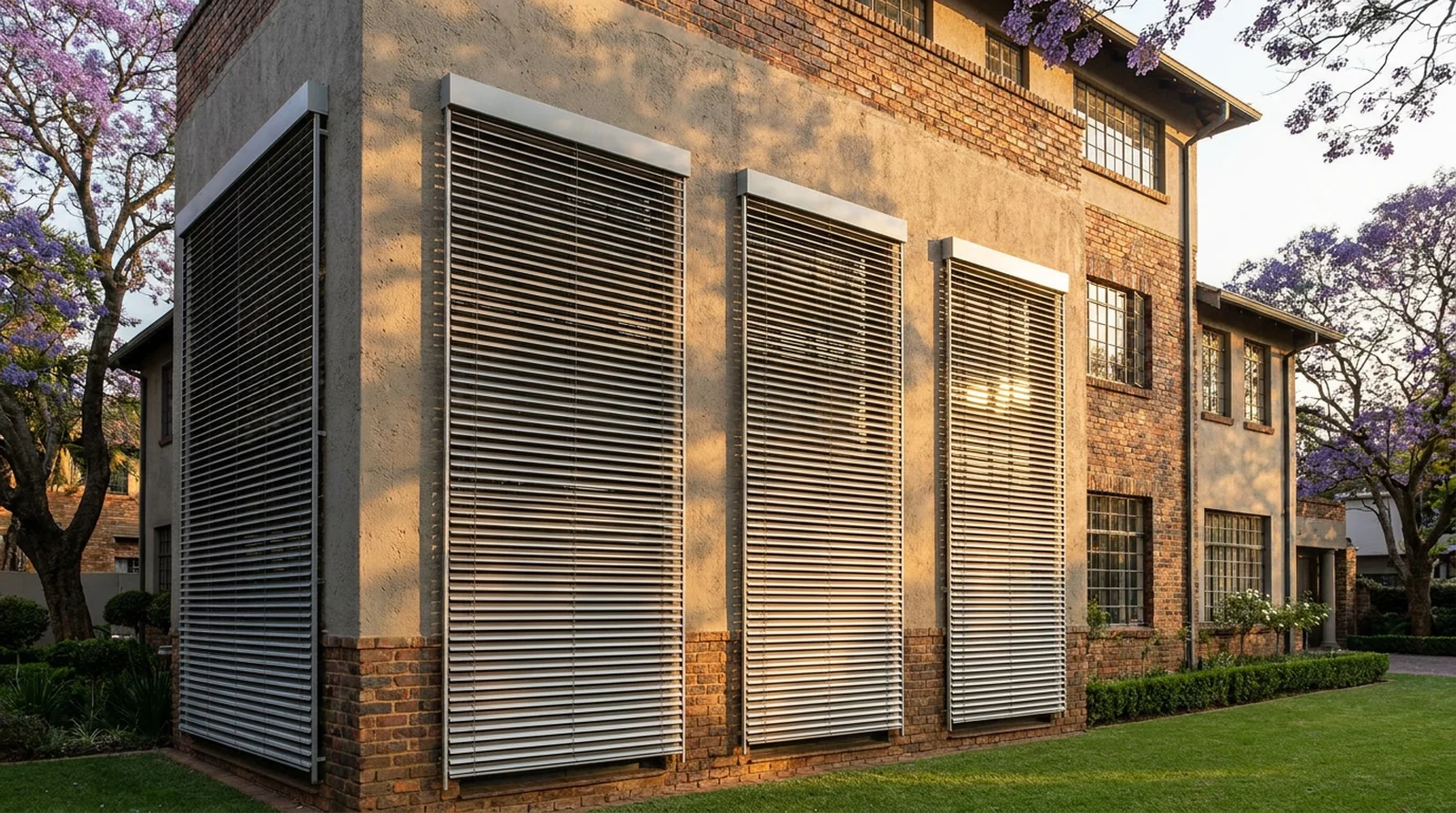
External venetian blinds — the hard west elevation
We would choose these over an interior blockout roller on a west window, because they stop the sun outside the glass. An interior blind blocks the light, but the pane still absorbs the heat and radiates it inward. Tilting slats keep some view, too.
The honest other sideA mechanism living outdoors, on a facade that may be heritage-controlled, and dearer than an interior blind. Where nothing may be fixed outside, a sunscreen roller is the sensible second best — it saves the glare, not the heat. -
Roller shutters — west wings and rooms that sleep
Where a room does not need daylight, rigid aluminium slats close the whole opening from outside: sun, heat and glare stopped at the sill, real blackout, and an insulating layer on a cold July night. These are shading shutters, not security-rated shutters — a different product, quoted on request.
The honest other sideA full stop rather than a dimmer: down means the window is gone. The headbox and side channels need somewhere to live — on a period facade, a design decision. -
Roller blinds — sunscreen mesh, or blockout
One smooth sheet of fabric on a tube; the whole decision is which fabric. Open-weave sunscreen keeps the garden and the tree line visible while cutting the glare. Blockout gives a solid face, which is what answers a low November sunrise on an east bedroom — closed slats still leak light where the sun arrives almost horizontally.
The honest other sideA mesh reverses after dark: once the light is inside, people see in better than you see out. A blockout fitted inside the reveal always leaves a thin light gap at each edge; fitted over the reveal it is darker, but sits proud of an original architrave. -
Timber & aluminium venetian blinds — sashes and studies
Where light needs steering rather than stopping, slats win: tilt for daylight with the glare taken out, close for privacy without dropping the blind. Timber suits a panelled study or an original sash; aluminium goes wherever there is steam or damp.
The honest other sideMore surfaces to dust than a roller, and a very wide opening needs an intermediate support or a split into two blinds — a call made better with the window in front of you. -
Cellular & honeycomb blinds — steel casements and cold rooms
Honeycomb cells hold a layer of still air against the glass. On the single-glazed steel casements common in Houghton's Art Deco and Modernist stock, that is the most useful thing you can hang in a winter room — dry highveld nights lose heat straight through old glass.
The honest other sideAn insulation and light-diffusion product, not a heat-rejection one. On a blazing west window it stays well behind exterior shading, because by then the heat is already inside the glass. -
Folding-arm awnings — the outside room
The terrace is where a Houghton house is actually used in summer, and an awning shades the paving and the glass behind it at once. Because highveld storms arrive in the afternoon — the hours an awning is out — we specify wind sensors so it retracts on its own.
The honest other sideA fabric structure in a garden with hail forecast from November to February. It must retract, and an old plastered wall may want a structural look before it takes the load. -
Motorisation & automation — the glass you cannot reach
On a double-volume stairwell, a wide slider or anything exterior, motorisation stops being a luxury. A sun sensor on the west drops the blind at the hour that matters whether anyone is home or not; a wind sensor outdoors saves the awning. It also takes every cord out of a nursery.
The honest other sideMotors need power at the head of the window, and routing cable through a heritage wall is a real conversation. Battery options avoid the chasing but must be recharged — a habit, not a technical fix.